

 Introduction
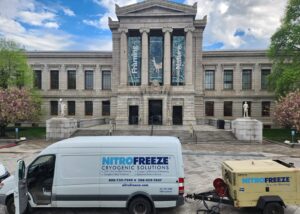
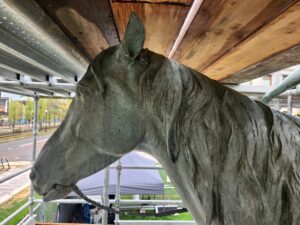
Preserving historic sculptures and statues requires cleaning methods that are both gentle and effective. Recently, our team had the opportunity to assist with the conservation of a bronze statue, Cyrus Dallin’s ‘Appeal to the Great Spirit’ at the Museum of Fine Art, Boston. The project highlighted how dry ice blasting technology can be used to safely remove contaminants and coatings previously applied while protecting delicate surfaces and preserving the integrity of the statue.
The Challenge of Conserving Bronze Sculptures
Every conservation project presents unique challenges, especially when working with historic bronze sculptures. Over time, outdoor exposure, environmental contaminants, and accumulated surface deposits can affect the appearance of a statue. Traditional cleaning methods may be too abrasive or can cause environmental concerns, making it important to identify a process that delivers precise cleaning without damaging the underlying material.
 How Our Dry Ice Blasting Process Works
On this project, we demonstrated the Cold Jet PCS-60 and the Aero 40FP. By carefully adjusting the parameters and refining the dry ice particle size, we were able to improve cleaning effectiveness while maintaining control over the process. Fine-tuning the particle size allowed us to target surface contaminants more precisely and achieve the desired level of cleaning.
One of the key advantages of dry ice blasting is that the dry ice sublimates upon impact, transforming directly from a solid to a gas. This means there is no secondary blasting media left behind, which reduces cleanup and makes the process particularly suitable for sensitive restoration applications.
Results of the Conservation
After testing, the cleaning process proved highly successful in restoring the statue’s surface while preserving its integrity. Ultimately, the Aero 40FP was chosen to complete the cleaning. The Aero 40FP is known for its ease of use, reliability and variability thanks to fragmenting nozzles. Following the cleaning phase, additional conservation steps were performed to protect the metal and ensure its long-term durability.
The conservation began with the application of a benzyl alcohol-based paint remover, which was applied across the entire surface and left overnight to effectively soften and lift remaining coatings. The following day, all residual stripper material was thoroughly removed using a hot-water pressure washer.
To provide lasting protection, a hot wax coating consisting of a National Parks Service wax mixture was then applied. The metal surface was heated to approximately 250°F, allowing the wax to melt into the substrate and be brushed evenly across the surface. After curing overnight, the wax coating was buffed to achieve a uniform finish. Select areas were then toned using pigmented paste wax to enhance visual consistency and restore the statue’s original appearance. Finally, a clear coat of paste wax was applied over the entire surface and buffed, creating a durable protective barrier against future environmental exposure.
Why Use Dry Ice Blasting for Sculpture Conservation Restoration?
Projects like this showcase the versatility of dry ice cleaning beyond industrial cleaning applications. Whether used for manufacturing or conservation, dry ice cleaning technology provides a unique combination of cleaning power and surface protection. For museums and institutions responsible for maintaining valuable works of art, this approach offers an effective way to restore the appearance while helping preserve the integrity of historic objects.
Conclusion
The Museum of Fine Arts, Boston’s, ‘Appeal to the Great Spirit’ statue project demonstrates how careful testing, the right equipment, and process optimization can deliver exceptional conservation results. Through testing the PCS-60 and Aero 40FP systems with refined particle sizing, we were able to develop a cleaning solution tailored to the needs of the customer, while helping bring new life to an important work of art. We can assist conservators with machine rentals and cleaning services, as well as demonstrations. To learn more contact 508-459-7447 or email info@nitrofreeze.com.