Wednesday, December 31, 2008

Cryogenic Treatment for Brake Rotors & Pads

At the Cryogenic Institute of New England, Inc. we process many brake rotors for cryogenic treatment. We cryo treat brake rotors and pads for recreational customers, but for the most part we do this service for commercial customers.

At the present, we cryo treat brakes for two ambulance fleets in Massachusetts. After speaking with the mechanics at both facilities, they have come to the conclusion that cryogenic treatment works on brake rotors very well. On average, they see 100% to 250% more longer life out of their brakes. This also greatly reduces their overhead costs because the brakes do not need to be changed as often as stock brakes. But, there are other reasons to cryo treat your brake rotors and pads.

Paul Deskins of Systems for Public Safety Inc. recently conducted a test between cryo treated and non-cryo treated brakes. Paul Deskins’ company builds and maintains Police Cars and Fire Trucks in Washington State. After the test, he found that the stopping distance when “hot” was 50 feet shorter with cryo treated brake rotors. As a result, he came to the conclusion that cryo treated brake rotors will prevent accidents. Paul’s testimonial can be seen below.

Purchasing a set of brakes and then having them cryo treated will result in shorter stopping distances in emergency situations. You will also save money because your brakes will last longer and you will not have to pay your mechanic several hundred dollars in labor for brake replacement. Cryogenic treatment on brakes also results in significantly less brake fade. Therefore, your brakes will offer consistent and predictable braking until they need to be replaced; if they ever need to be.

For more information about cryogenic treatment visit http://www.nitrofreeze.com/cryogenic_treatment.html. To view our racing page visit http://www.nitrofreeze.com/racing.html.


Paul Deskins' Testimonial:

Hi Robin,

I own a Company in Washington State that builds and maintains Police Cars/Fire Trucks. We recently did a brake test on several brake rotors on Police cars. I took one OEM set and had them Cryo treated and they out performed every rotor in the test-Fade and stopping distance. The officers took the data from the test to the City Admin staff and showed that if the fleet was fitted with Cryo brakes it would prevent accidents. The stopping distance “hot” was almost 50 Feet shorter than the rest!

Thanks,

Paul Deskins
Systems for Public Safety Inc.
10203 Lakeview Ave SW
Lakewood WA 98499
Phone: 253-983-1103
Fax: 253-983-1101
paul@systemsforpublicsafety.com

Labels: , , , , , ,

Monday, December 22, 2008

How To Keep That Crankshaft From Breaking, Period

This year we cryo treated many crankshafts to help our customers. These customers had recently purchased crankshafts to help assure that they would not fail like their original ones did. After seeing so many crankshafts, it makes you wonder why they fail. After a little research, it became apparent why they fail. The two main reasons can be found below.

  1. The Wrong Crankshaft: A stock crankshaft is made for a car that is left in its stock state. When a racer decides to add more torque and horsepower to their application, they put more stress on the stock crankshaft. Some stock crankshafts can handle some added power, but most cannot. There are many ways to solve this problem. One is to purchase a stronger crankshaft that is made to deal with the extra stress of higher horsepower and torque. Another is to take the stock or aftermarket crankshaft and cryo treat it to remove residual internal stresses that can contribute to crank failure. Other alternatives include the application of surface coatings.
  2. Flawed Vibration Dampers: Stock dampers tend to have moving parts. For example, some crankshaft dampers have hydraulic oil in them. As the crankshaft rotates the fluid in the damper causes inertia. The end result is more stress on the crankshaft, which in time will lead to crank failure. Many aftermarket crankshaft manufacturers have found that lighter and smaller vibration dampers are better for racing applications. A small solid piece of rubber as a vibration damper is much better than one filled with hydraulic oil, because it will not cause inertia.

The bottom line is if you are going to add a ton of power to your engine, then you should expect a failure of your original stock crankshaft at some point. The way to ensure that a failure does not happen is to purchase a stronger crank or have your OEM or aftermarket crankshaft cryogenically treated. At the same time, if you are increasing power you should look for an aftermarket vibration damper that does not cause extra stress on the crankshaft. For more information about cryogenic treatment for racing components, take a look at http://www.nitrofreeze.com/racing.html.

Labels: , , , , , , , , ,

Tuesday, December 2, 2008

Cryogenic Deburring

This press release was released over the internet today. However, I wanted to add it to our blog for all of our customers to see.

Nitrofreeze® Cryogenic Deburring Service Expands

Worcester, MA - December 2, 2008 - The Cryogenic Institute of New England, Inc. is pleased to announce expanded capabilities for the removal of machine burrs from complex machined parts. The process, known as Nitrofreeze® cryogenic deburring service, has been adopted by a wide range of customers in diverse industries including medical devices, aerospace, automotive, and process control, among others. Nitrofreeze® cryogenic deburring service is ideal for today’s advanced materials, including most plastics, composites, organics, polymers and advanced synthetics.

“The adoption of these advanced materials by engineers has expanded the market for associated finishing processes and the company’s Nitrofreeze® cryogenic deburring service has filled this niche”, according to Robin Rhodes, President of the Cryogenic Institute of New England, Inc. The company first offered its cryogenic deburring process in 2003 and it has since become one of its fastest growing product lines.

Many of the parts that benefit from this unique form of burr removal have intricate shapes that are cut or milled on sophisticated CNC machines. They contain critical dimensions and have strict requirements for a blemish free surface finish. The Nitrofreeze® cryogenic deburring process is able to protect the surface finish and critical dimensions of the parts during burr removal because the parts are processed in a cryogenically frozen condition. This not only protects the part, it also promotes the clean removal of the undesired machine burrs when precisely attacked by the systems cryogenic-grade polycarbonate blasting media.

“One of our biggest challenges is that many potential customers in need of machine burr removal solutions, including machinists, manufacturing engineers and quality managers, have not heard of Nitrofreeze® cryogenic deburring,” according to Ryan Taylor, Product Marketing Specialist at Cryogenic Institute of New England, Inc. “This is despite the fact that our cryogenic deburring offers many advantages, including consistent cleaning, repeatable results, and our ability to remove burrs in recessed and blind holes as small as 0.015 inches”, he added.

The company processes parts for customers on a job-shop or service basis. Typical batch sizes range from dozens of individual components to tens and even hundreds of thousand per week. Typical turnaround time is within a few days of receipt and fast turn service for prototype of other rush parts can be accommodated for a small premium charge. The process is environmentally-friendly, clean, fast and cost effective – especially when compared to other alternative deburring processes.

More information is available at the company’s web page http://www.nitrofreeze.com/deburring.html.

The Cryogenic Institute of New England, Inc., located at 90 Ellsworth St. Worcester, Massachusetts, USA, (508) 459 7447, is dedicated to the commercial application of cryogenic technologies to serve the needs of industry, government and scientists. The firm offers a full range of Nitrofreeze® cryogenic services, including cryogenic burr removal service, cryogenic deflashing services, conventional cryogenic treatment, heat & freeze thermal cycling, shrink fitting services, and dry ice (CO2) blast cleaning. It also offers engineering services, cryogenic lab work in support of R & D, and custom equipment design for new and unique cryogenic applications. It is a corporate sustaining member of the Cryogenic Society of America and ASM-The Material Society.

Labels: , , ,

Tuesday, November 11, 2008

Dry Ice Blasting Industrial Equipment


Dry Ice Blast Cleaning also known as dry ice blasting and co2 blasting has been one of our service offerings for the past two years. We have completed many jobs involving industrial equipment, fire damage, and mold remediation. Dry ice blasting is a very different yet environmentally friendly cleaning process.

Unlike sand blasting and pressure washing, dry ice blasting is approved by the FDA, EPA, and USDA. Why does that matter some may ask? The answer is simple, it allows us to clean food processing lines and equipment along with other medical applications.

Sand blasting leaves sand and grit all over the area to be cleaned; pressure washing leaves a slippery wet mess on the floor. These two cleaning processes cannot be used on every application for the cited reasons. Dry ice blasting doesn't leave anything on the floor except the grit from the surface that was cleaned. The dry ice (aka co2) that we use comes in pellet form. This means that it is about the size of a tic-tac. As the operator uses the dry ice blasting equipment, dry ice is blasted at the surface and evaporates as it cleans the surface. Therefore, there is no wet mess on the floor.

The most important principle that differentiates dry ice blasting from sand blasting and pressure washing is the fact that dry ice blasting is non-abrasive. Picture a brick wall that was painted white. Sand blasting it would take off the paint, destroy some of the grout, and damage the surface finish to the bricks. Pressure washing may take off some of the paint, but probably not all and don't forget the gallons of water all over the floor. Dry ice blasting will remove the paint, but keep the grout and surface finish to the bricks just the way it was before the bricks were painted.

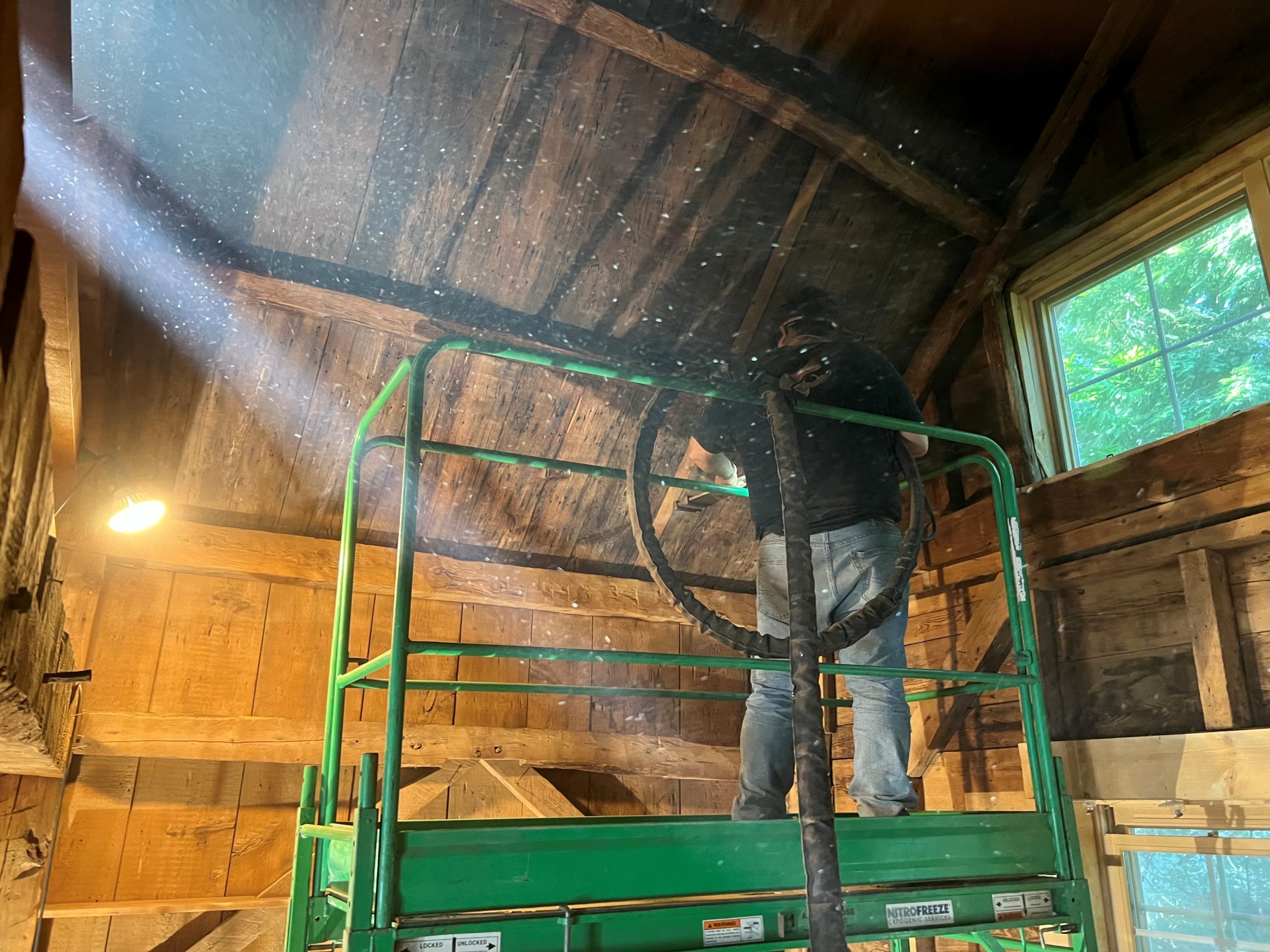
Dry ice blasting can be used on different surfaces including metal, brick, wood, stone, and many others. The picture above shows our president helping us clean the Telegram & Gazette's main printing press located in Worcester, MA. Our company offers dry ice blasting throughout the whole New England area. For more information take a look here at http://www.nitrofreeze.com/dry_ice_blast_cleaning.html.

Labels: , , , , , , , , , ,

Tuesday, November 4, 2008

Cryogenic Treatment for Racing and Automotive Parts

In the recent weeks, I have seen a jump in interest regarding cryogenic treatment for automotive parts. Many of these customers have a lot of questions, and we are more than happy to answer them.

Cryogenic treatment works on many different racing components. But many ask why would one want to have their parts cryogenically treated? There are several different reasons. Your parts will last longer. The residual stresses in the material will be relieved, which will result in a more uniform grain structure. This reduces the chance of failure within your part. The parts will also have a higher resistance to wear. Take a look at this article published in Race Engine Technology magazine, http://www.nitrofreeze.com/RETP3034Cryo.pdf.

I can tell you that we have treated many crankshafts, transmission gear sets, pistons with rings, and connecting rods this year. There are many other applications for the racing industry, that can be seen here, http://www.nitrofreeze.com/racing.html. There are other parts we can cryogenically treat as well, just call and we will be glad to help.

Labels: , , , , , , ,

Wednesday, August 27, 2008

DieBlast Cryogenic Deflashing & Deburring Media Won't Work For Us

The last blog post I made was about the introduction of DieBlast Cryogenic Grade Polycarbonate Media into our facility. We were able to try a sample of both the .020 and .060 media.

Our first sample was a current part that we already run for one of our present customers using the .020 media. We split the order into three batches. One was using our current Maxi-Blast media for the original cycle time of ten minutes. Out of a set of 230 parts, 26 parts were rejected. This means that 12% out of 230 parts needed to be run a second time. You would think 12% was high but then we ran the DieBlast media.

When we were offered a sample of DieBlast, we were told that it reduces cycle times, and cycle rpms, as well as liquid nitrogen intake. No matter what we would not change the temperatures of our recipes. So the only way liquid nitrogen intake would be reduced is by shorter cycle times. We ran the same rpm for the throw wheel and a seven minute cycle instead of a ten minute. Out of 230 parts, 55 parts were rejected. So 24% out of 230 parts needed more time to remove all the burrs. Then we ran our third lot which was identical to the original recipe besides the fact that it was using DieBlast media. Out of 230 parts, 44 were rejected. 19% of 230 parts needed a longer cycle time.

Needless to say, I was surprised by the results and expected DieBlast to do a lot better. It failed to meet our expectations. Therefore, we will continue to use Maxi-Blast and Polyblast media that we have always used. Their media is very similar in shape and lifetime.

Friday, August 22, 2008

DieBlast Cryogenic Grade Polycarbonate Deflashing & Deburring Media

After a few weeks of waiting our new cryogenic grade media arrived for our cryogenic deflashing and deburring operations.

For the time being, we get to try samples of both .020 and .060 media by Dieblast. Dieblast is currently made in the United Kingdom. The media is different from it's competitors Maxiblast and Polyblast because the media is in a cube shape versus drum shape.

As a result, the media has 16 cutting edges versus 2 on the current media we have been using. The photo shows two piles of the Dieblast media. The .060 is on the left and the .020 is on the right. Next to both those piles are a sample of the current media we have been using.

Unfortunately, we haven't actually been able to run a sample using the Dieblast media yet. But, once we run a few samples with it, I will report back and post our results using this new type of media.